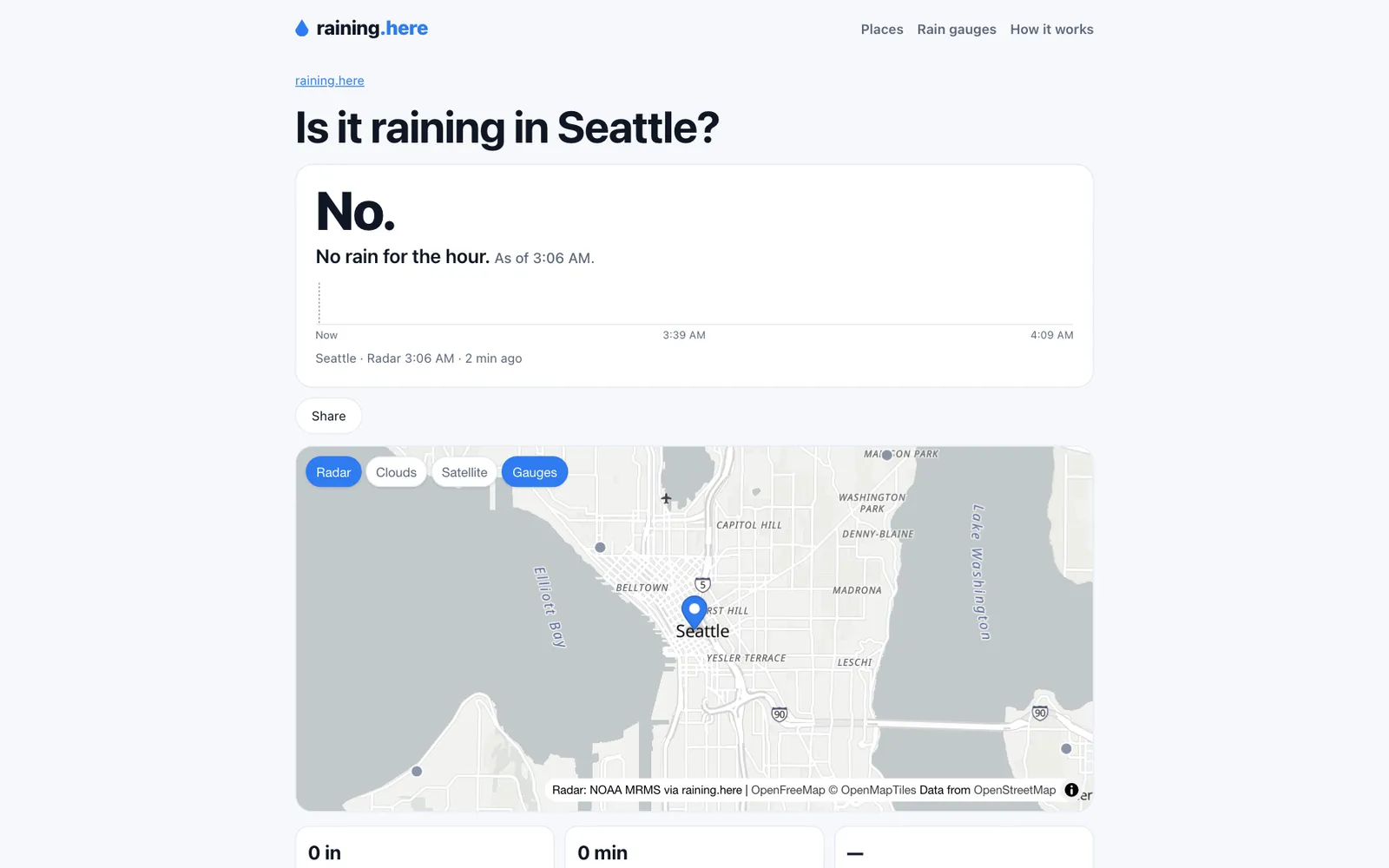
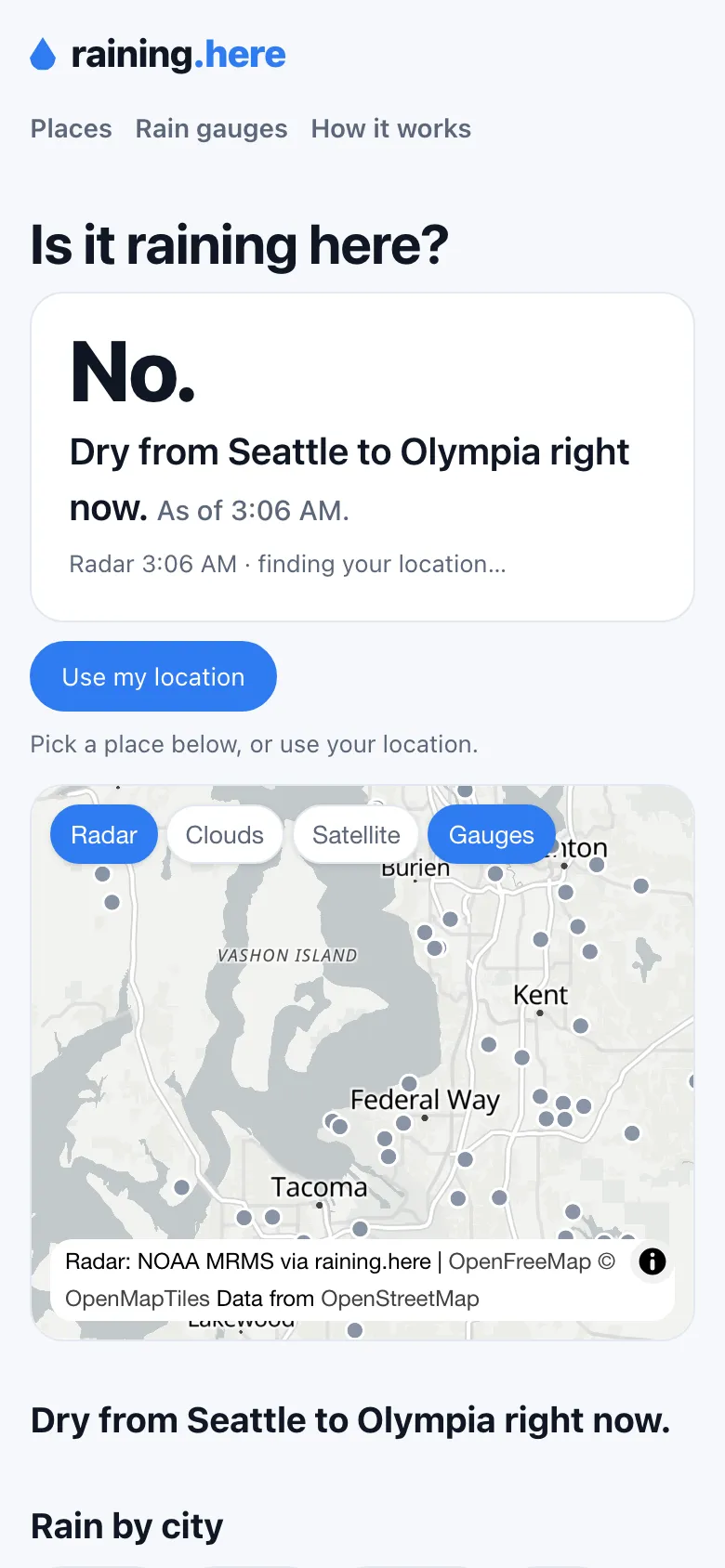
raining.here — Next-Hour Rain
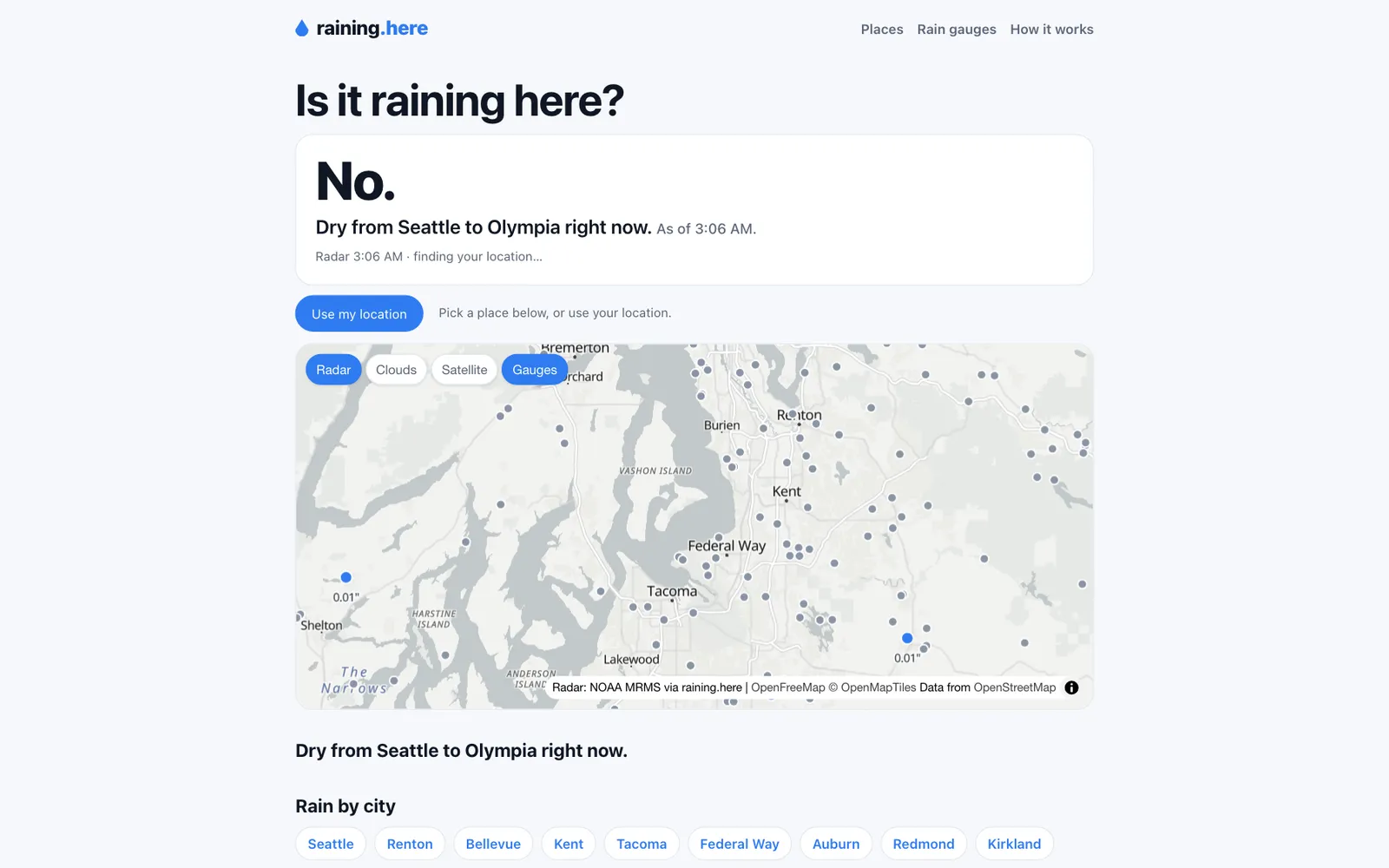
Street-level rain for the Seattle–Tacoma area, now and minute by minute for the next hour, built from NOAA radar and a motion nowcast, scored against the radar every hour, like the original Dark Sky.
01 / Problem
Bringing back the Dark Sky answer for Puget Sound
“Will it rain on me in the next 20 minutes?” is the most useful weather question there is, and the app that answered it best was bought and shut down. NOAA's radar is free, but raw radar is not an answer: it sees clutter and birds, overestimates in the melting layer, looks 1–3 km above the ground over the Sound, and says nothing about where the rain will be in half an hour.
02 / Live demo
Rain across Puget Sound right now
Live demo · Rain across Puget Sound
Reading the radar…
03 / Radar processing
Production path, and the challenger being scored against it
In production
01 →
Rain now: NOAA MRMS
The national mosaic (Camano Island, Langley Hill, Portland and others merged, clutter removed) read 2–3 min after each 2-minute scan, on a ~1 km grid.
02 →
Next hour: radar nowcast
LibreWXR carries the rain along its measured motion in 10-minute steps to ~55 min, the same feed rntwx.com uses, so the two sites agree.
03 →
Per-place answer
Rain = ≥ 18 dBZ within ~500 m. Start/stop times rounded to 5 min because the forecast is not finer than that.
On the test bench: my own Level II processing
01 →
KATX Level II
Read from NOAA's real-time chunks about a minute after each low scan, so it can beat the mosaic's latency.
02 →
Quality control
Drop non-weather echo where correlation coefficient ρhv < 0.85: clutter, birds, chaff.
03 →
Bright band + VPR
Subtract bias in the melting layer (ρhv < 0.97); add back rain that falls as snow above it.
04 →
Wind drift, then Z = aRᵇ
Move each gate to where its rain lands through that hour's wind profile, on a 250 m grid.
05 →
Phase-correlation nowcast
Field advected along its own motion, steadied toward the 1.5 km wind; chance spreads with lead time.
06 →
Backtest
Scored against ASOS and CoCoRaHS gauges. It replaces the production path only when it wins.
The whole service runs in one container on a home server at 5–20% of one core and ~500 MB, behind its own Cloudflare tunnel.
04 / Benchmarks
Checking ourselves, in public
| Measure | Value |
|---|---|
| Next-hour forecasts scored (Nov 1–21) | 4,002 |
| Matched what the radar then saw | 100% |
| …of which hours stayed dry | 100% |
| Radar refresh | every 2 min |
| Frame size / history kept | ~50 KB · 24 h |
05 / Engineering decisions
Publish the known failure modes
Drizzle under the beam, showers that form overhead and drifting rain are listed on /how. Trust comes from saying what it gets wrong.
A method changes only when it wins
Every 5 minutes each place's forecast is logged; every 2 minutes the radar truth. My own KATX processing and faint-edge tracking must beat the current method before they ship.
Answer-first pages for search and AI
Each of 90+ places is server-rendered with an answer H1, live FAQPage schema, Place coordinates and a share image, plus llms.txt and an OpenAPI spec.
Cache at the edge, not in the app
HTML caches 60 s at Cloudflare and frames cache for a year, so traffic spikes during storms never reach the home server.
06 / Comparison
raining.here vs. general-purpose weather apps
| raining.here | General weather apps | |
|---|---|---|
| Focus | Next-hour rain, Seattle–Tacoma only | Everything, everywhere |
| Method | Documented on /how, with known failure modes | Usually undisclosed |
| Accuracy reporting | Scored hourly, published on site | Rarely published |
| Open API | Free JSON + OpenAPI | Paid or none |
| Ads | None | Common |
07 / Screens